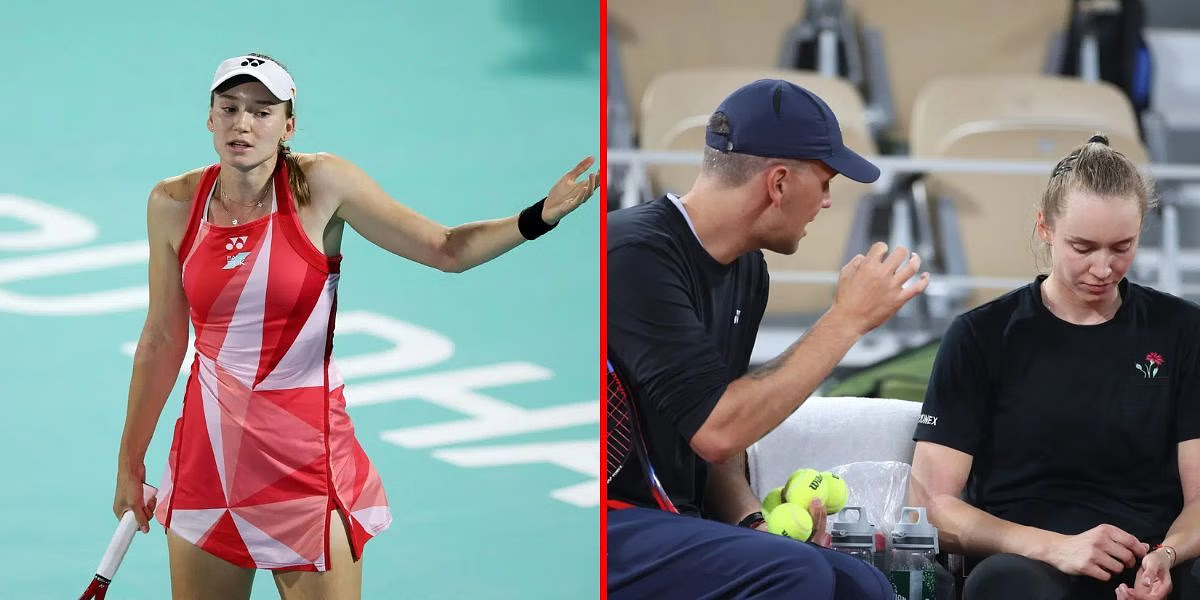
Why Raducanu Still Struggles Against the Elite — and Why Fitness Is Only Part of the Story
Deprecated: preg_split(): Passing null to parameter #3 ($limit) of type int is deprecated in /home/ecoirdaz/facetechcourses.com.ng/wp-content/themes/jannah/framework/functions/post-functions.php on line 863


The claim that Emma Raducanu is “not a match for the best in women’s tennis” has become a familiar refrain, often anchored to concerns about her ongoing fitness issues. There is truth in that assessment—but the data suggests fitness alone does not fully explain the gap between Raducanu and the sport’s elite. Instead, the divide is structural, multi-layered, and increasingly measurable.
At the top level of the WTA Tour, durability is not just about avoiding injury; it is about sustaining performance density across long matches and long seasons. Since her US Open triumph in 2021, Raducanu has averaged significantly fewer matches per season than her top-10 peers. Elite players typically log 55–70 matches annually. Raducanu has often fallen well short of that mark. The consequence is not simply rust, but a reduced tolerance for repeated high-intensity scenarios—the kind that define matches against the very best.
Fitness data from recent seasons shows a clear pattern. Against top-10 opponents, Raducanu’s win percentage drops sharply compared to her record against players ranked outside the top 30. More telling is how those losses unfold. Her performance tends to decline as matches progress: first-set competitiveness gives way to second-set drop-offs in serve speed, first-serve percentage, and rally depth. These trends are consistent with players whose physical base is good enough to compete, but not robust enough to sustain elite-level intensity.
However, attributing this gap purely to fitness risks oversimplifying the problem. Even when Raducanu is physically sound, her underlying match metrics lag behind the top tier. Serve effectiveness remains a major differentiator. The best players in women’s tennis routinely win 65–70% of points behind their first serve. Raducanu’s figure against elite opponents often sits closer to 55–58%. That discrepancy places constant pressure on her return games and inflates the physical toll of matches, creating a feedback loop where fitness and performance erode together.
Rally dynamics offer further insight. Raducanu is an excellent mover and defender, but the modern women’s game increasingly rewards players who can end points decisively within the first five shots. Against the top players, Raducanu’s winner count per set is consistently low. She extends rallies but struggles to flip defensive positions into offensive advantage. Over time, that forces her to play longer points, which amplifies any physical disadvantage and exposes stamina limitations.
This is where fitness becomes a multiplier rather than a root cause. The elite are not simply fitter; they are more efficient. They shorten points, protect their serve, and conserve energy through proactive patterns. Raducanu, by contrast, is often required to do more physical work to achieve the same scoreboard outcome. Even small deficits in conditioning become magnified under those conditions.
There is also the issue of continuity. Fitness is not built in isolation; it is reinforced through uninterrupted training blocks and competitive rhythm. Raducanu’s stop-start seasons—driven by injuries, recovery periods, and schedule recalibration—have limited her ability to layer physical gains over time. Sports performance research consistently shows that intermittent availability slows long-term athletic development, even if peak condition is occasionally restored.
Critically, this does not mean Raducanu lacks the tools to compete with the best. Her anticipation, timing, and baseline control remain high-level. But at the elite end of women’s tennis, marginal gains decide outcomes. A few percentage points on serve, slightly higher rally aggression, and greater physical repeatability can collectively shift a player from competitive to threatening.
The question, then, is not whether Raducanu needs to solve her fitness issues—she does—but whether those solutions are integrated into a broader tactical and physical framework. Without improvements in serve efficiency and point construction, even perfect fitness would only narrow the gap temporarily. Conversely, better efficiency would reduce physical strain, making fitness gains more sustainable.
In that sense, the assertion that Raducanu is “not a match” for the best is accurate only in the present tense. The gap is real, measurable, and persistent. But it is also defined by solvable margins rather than insurmountable flaws.
To bridge it, Raducanu must do more than get fitter. She must become harder to play.
Deprecated: preg_split(): Passing null to parameter #3 ($limit) of type int is deprecated in /home/ecoirdaz/facetechcourses.com.ng/wp-content/themes/jannah/framework/functions/post-functions.php on line 863