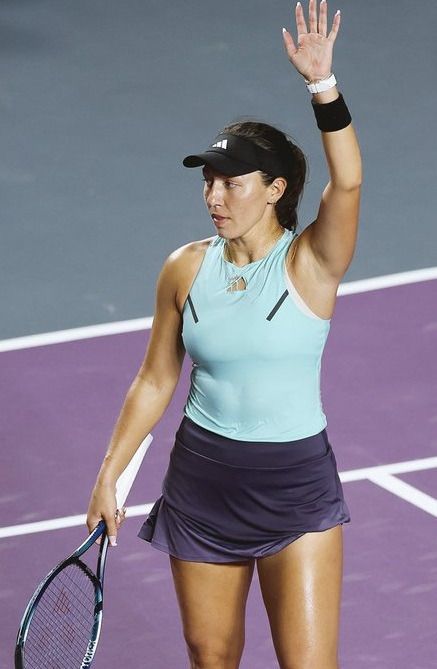
What does the tattoo on Jessica Pegula’s back say? On her back underneath her left shoulder, Pegula has a phrase written out and flipped vertically.
Deprecated: preg_split(): Passing null to parameter #3 ($limit) of type int is deprecated in /home/ecoirdaz/facetechcourses.com.ng/wp-content/themes/jannah/framework/functions/post-functions.php on line 863


What Does the Tattoo on Jessica Pegula’s Back Say — and Why It Fits Her Career
The tattoo on Jessica Pegula’s back is easy to miss during matches, partly because it sits beneath her left shoulder and partly because it is written vertically rather than horizontally. But once noticed, it offers a revealing insight into the mindset of one of the most consistent players in modern women’s tennis.
The phrase reads: “I will either find a way or make one.” Pegula has explained that it is written in Latin and flipped vertically, a stylistic choice that makes it more personal than performative. She revealed the meaning during an appearance on Rennae Stubbs’ show The Power Hour, describing it as a guiding principle rather than a decorative statement.
The quote itself is often attributed to Hannibal, the Carthaginian general, and is commonly translated from Aut viam inveniam aut faciam. While the historical attribution is debated, the sentiment is clear: persistence over circumstance, solutions over excuses. In Pegula’s case, the message maps closely onto the shape of her professional career.
Statistically, Pegula is not defined by sudden spikes or dramatic breakthroughs. Instead, her rise has been incremental. She entered the top tier of women’s tennis later than many of her peers and built her ranking through accumulation rather than explosion. Over the past several seasons, she has ranked among the tour leaders in win percentage against top-20 opponents, quarter-final appearances, and match consistency across surfaces. That profile aligns far more with “finding a way” than forcing one moment of dominance.
The tattoo’s placement and orientation also matter. Written vertically and partially concealed, it is not designed for broadcast cameras or social media clips. That fits Pegula’s broader public persona. Unlike many contemporaries, she has avoided cultivating a highly stylised on-court identity. Her game, like her branding, is understated: efficient movement, controlled aggression, and tactical discipline rather than flair-driven risk.
From a performance-analysis standpoint, the quote reflects how Pegula wins matches. She rarely overwhelms opponents with raw power. Instead, she adjusts patterns, absorbs pressure, and exploits small drops in execution. Data from recent Grand Slams shows that Pegula wins a high percentage of extended rallies and second-serve points, two metrics closely associated with adaptability. When Plan A stalls, she does not spiral; she recalibrates.
The tattoo has drawn renewed attention during her deep runs at majors, particularly at the Australian Open, where her consistency over two weeks highlighted the very philosophy the quote expresses. Pegula did not dominate every match, but she repeatedly solved problems presented by different playing styles. In several contests, her average level remained stable while opponents’ margins collapsed under sustained pressure.
There is also a subtle contrast between the tattoo’s message and the external narratives often attached to Pegula. As the daughter of billionaire sports owners, she has frequently faced assumptions about ease or access. Yet her career data tells a different story. She has logged heavy match volumes, endured early-round losses at majors before breaking through, and spent years converting quarter-final appearances into deeper runs. The tattoo’s wording reads almost as a quiet rebuttal to the idea that paths are simply given.
In elite sport, tattoos often function as identity markers — declarations of belief, resilience, or memory. Pegula’s is no different, but its restraint is telling. It is not celebratory, commemorative, or reactive. It is conditional and forward-looking: either find a way or make one.
As Pegula continues to push toward Grand Slam titles, the phrase feels less like inspiration and more like description. Her career has been built on solving problems one round at a time. The tattoo does not explain her success on its own, but it captures the logic behind it — progress through persistence, not shortcuts.
In a sport decided by margins, that mindset may be as permanent as the ink itself.
Deprecated: preg_split(): Passing null to parameter #3 ($limit) of type int is deprecated in /home/ecoirdaz/facetechcourses.com.ng/wp-content/themes/jannah/framework/functions/post-functions.php on line 863