‘Greaves Taking the Spotlight Will Help Fallon’ — Why Sherrock’s Role Is Quietly Shifting Again
Deprecated: preg_split(): Passing null to parameter #3 ($limit) of type int is deprecated in /home/ecoirdaz/facetechcourses.com.ng/wp-content/themes/jannah/framework/functions/post-functions.php on line 863

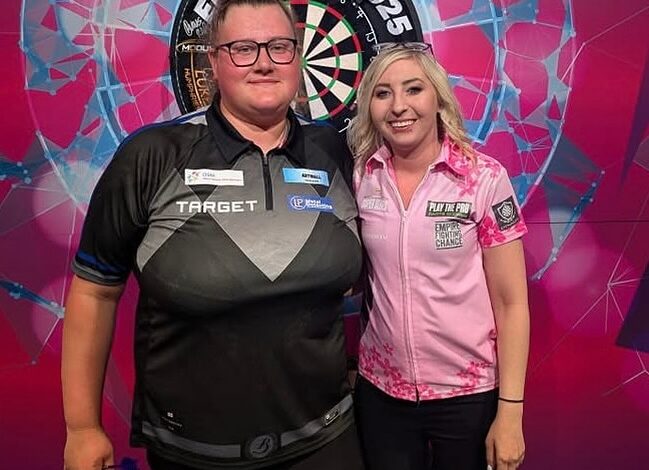
After Fallon Sherrock’s failure to secure a PDC Tour Card for 2026 at Q-School, the immediate reaction focused on what she had missed out on. No Tour Card, no regular ProTour access, and another year operating largely outside the main PDC circuit. On paper, it looked like another setback. But Sky Sports Darts pundit Laura Turner’s assessment — that Beau Greaves taking the spotlight could actually benefit Sherrock — points to a deeper shift in the women’s game and in Sherrock’s place within it.
For much of the past five years, Sherrock has carried a disproportionate share of attention. Since her historic breakthrough at the World Darts Championship, she has been the reference point for women in the PDC system. With that visibility came pressure. Every result was framed symbolically, every defeat scrutinised as a verdict on progress or failure. That burden is now easing.
Greaves’ dominance has changed the narrative. Sitting comfortably atop the Women’s Series Order of Merit with £37,600 in prize money, Greaves has become the statistical benchmark. Her scoring ceiling, volume of titles, and week-to-week consistency have shifted expectations of what elite performance in the women’s game looks like. In doing so, she has absorbed much of the spotlight Sherrock once carried almost alone.
From a performance-analysis perspective, that redistribution matters. Sherrock’s recent career has been shaped as much by structural strain as by form. Without a Tour Card, every opportunity comes through short-format qualifiers where variance is extreme. Q-School, in particular, is unforgiving. Data from previous editions shows that players averaging competitively across multiple matches can still fall short due to a handful of missed doubles or unfavourable draws. Sherrock’s underlying numbers at Q-School did not indicate collapse — they indicated fine margins.
Laura Turner’s point cuts to the psychological and strategic implications of that reality. Sherrock no longer needs to be everything at once: trailblazer, proof-of-concept, and weekly contender. Greaves’ presence allows Sherrock to exist as a competitor again, rather than a symbol. Historically, athletes perform more sustainably when expectation aligns with role rather than narrative.
There is evidence this shift is already happening. Sherrock currently sits second on the PDC Women’s Series Order of Merit with £14,600 in earnings, ahead of Lisa Ashton and Noa-Lynn van Leuven. While the gap to Greaves is significant, holding second place confirms Sherrock’s continued relevance at the top of the women’s field. Importantly, her recent results show reduced volatility — fewer extreme low performances and tighter average ranges — suggesting a rebuilt floor after health-related disruption.
That health context remains central. Sherrock’s kidney condition, first treated in 2017, requires ongoing management and has shaped how she schedules and competes. The grind of chasing a Tour Card while managing recovery is considerably harsher than competing with guaranteed access. Stepping away from that pursuit does not necessarily signal retreat; it can signal recalibration.
Turner’s analysis also reflects a broader evolution in women’s darts. The game is no longer reliant on one figure to demonstrate viability. Depth has increased, pathways are clearer, and the competitive ecosystem is more robust than it was when Sherrock first broke through. In that environment, Sherrock’s experience becomes an asset rather than a burden. She understands stage pressure, media scrutiny, and the realities of competing without structural security.
What comes next, then, is less about chasing immediate redemption and more about strategic positioning. Women’s Series events, major qualifiers, and televised tournaments still offer Sherrock platforms where her experience often translates well. Historically, her performances on bigger stages have outperformed her week-to-week averages, suggesting she remains well-suited to selective engagement.
Financially, Sherrock is also better placed than most. With an estimated net worth reported to exceed £1 million, driven largely by sponsorship and media work, she is not forced into over-scheduling to survive. That flexibility allows her to prioritise health and performance sustainability rather than volume — a luxury few in darts possess.
Greaves taking the spotlight does not diminish Sherrock’s legacy. If anything, it completes it. Sherrock opened the door; Greaves is sprinting through it. That dynamic allows Sherrock to redefine her role on her own terms.
The absence of a Tour Card will limit opportunities, but it does not erase relevance. Sherrock has been flying the flag for years. Now, with the flag firmly planted, she may finally be free to compete without carrying it alone.
Deprecated: preg_split(): Passing null to parameter #3 ($limit) of type int is deprecated in /home/ecoirdaz/facetechcourses.com.ng/wp-content/themes/jannah/framework/functions/post-functions.php on line 863