Emma Raducanu: British No 1 takes positives from Transylvania Open final defeat and says she is finding her ‘identity’ on the court
Deprecated: preg_split(): Passing null to parameter #3 ($limit) of type int is deprecated in /home/ecoirdaz/facetechcourses.com.ng/wp-content/themes/jannah/framework/functions/post-functions.php on line 863

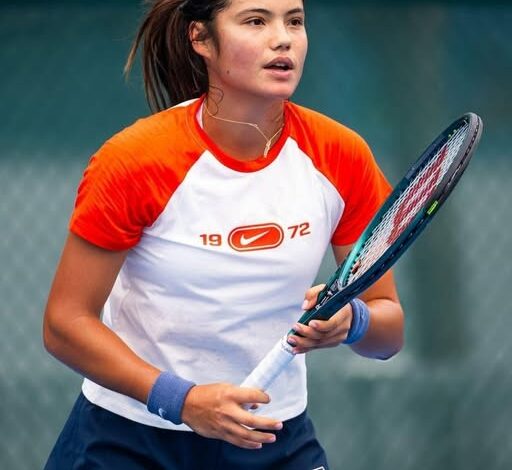
Emma Raducanu Finds Positives in Transylvania Open Final Defeat as Search for ‘Identity’ Takes Shape
Emma Raducanu may have fallen short in the Transylvania Open final, but the British No 1 emerged from Cluj-Napoca with something she has been openly searching for since her US Open triumph: clarity. Speaking after the defeat, Raducanu described the week as an important step in “finding my identity on the court,” framing the loss not as a setback but as evidence of forward momentum in a career still defined by transition.
Reaching the final marked Raducanu’s deepest run of the season and one of her most complete tournament performances in recent years. It required navigating multiple matches in succession, managing physical load, and adapting tactically across rounds — areas that have challenged her since injuries and interrupted schedules became recurring themes. From a results perspective, the final loss was disappointing. From a performance perspective, it was constructive.
Statistically, Raducanu’s week in Romania showed meaningful trends. Her baseline tolerance improved round by round, and she generated a higher percentage of break-point opportunities than she has managed at several recent events. While her serve efficiency dipped in the final — particularly under physical strain — her return numbers across the tournament were among her strongest in months. That balance suggests a player rebuilding her game from the ground up rather than relying on isolated peaks.
Central to that process has been her work with LTA coach Alexis Canter, a partnership Raducanu referenced positively after the final. Rather than radical overhaul, the emphasis has been on simplifying patterns and reinforcing strengths: early ball striking, court positioning, and controlled aggression. Those elements were visible throughout the week. Raducanu looked more decisive in neutral rallies and more willing to step inside the baseline, even when execution wavered late in matches.
The idea of “identity” is significant. Since her breakthrough in 2021, Raducanu’s game has often been described in terms of potential rather than definition. Injuries, coaching changes, and limited match volume have prevented sustained development of a recognisable style. At Cluj-Napoca, that began to change. While not yet complete, there was a clearer sense of how Raducanu wants to win points, rather than simply reacting to opponents.
The final itself exposed the remaining gaps. Physically, Raducanu acknowledged the toll of a long week, describing the match as emotionally and physically difficult. Performance data supports that assessment. Her first-serve effectiveness declined compared to earlier rounds, and her movement intensity dropped as rallies extended. Against a fresher opponent, those margins proved decisive. This was less about tactical failure and more about endurance — an issue Raducanu has consistently identified as a work in progress.
Importantly, her response avoided pessimism. In previous seasons, finals losses or early exits often triggered broader questions about direction. This time, Raducanu’s focus was narrow and practical. She spoke about progress, learning, and continuity. That shift in tone reflects a more grounded phase of her career, where expectations are recalibrated toward process rather than instant results.
From a broader tour perspective, Raducanu’s run highlights a familiar challenge for players rebuilding after disruption. Match volume is essential for sharpening competitive instincts, but volume also exposes physical limits. Finding the balance between the two is difficult, particularly for a player whose body has not yet adapted to sustained weeks on tour. The Transylvania Open provided valuable data points — both encouraging and cautionary — as Raducanu continues that calibration.
There are also ranking implications. A finals appearance boosts Raducanu’s position and reduces immediate pressure to chase points week-to-week. That breathing room can allow for more deliberate scheduling, a factor that performance analysts consistently link to improved durability over time. For Raducanu, the ability to choose tournaments strategically may prove as important as any technical adjustment.
The partnership with Canter appears to fit that long-term approach. Rather than chasing quick fixes, the focus has been on rebuilding trust in her game and body. Raducanu’s comments suggest growing confidence in that process, even
Deprecated: preg_split(): Passing null to parameter #3 ($limit) of type int is deprecated in /home/ecoirdaz/facetechcourses.com.ng/wp-content/themes/jannah/framework/functions/post-functions.php on line 863