Coco Gauff’s Australian Open Exit Exposes How Thin the Margins Still Are at the Elite Level
Deprecated: preg_split(): Passing null to parameter #3 ($limit) of type int is deprecated in /home/ecoirdaz/facetechcourses.com.ng/wp-content/themes/jannah/framework/functions/post-functions.php on line 863

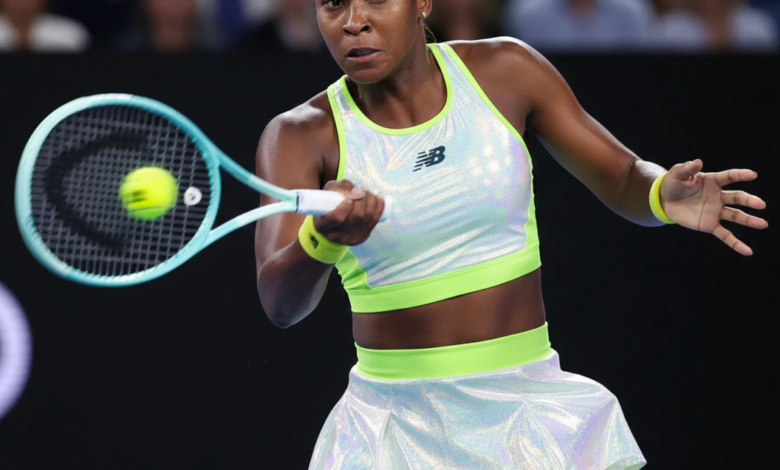
Coco Gauff’s Australian Open campaign ended abruptly and painfully, a straight-sets quarterfinal defeat completed in just 59 minutes that left the American visibly frustrated, smashing her racket as the reality of elimination set in. On the surface, the result looked like a collapse. In context, it was a reminder of how unforgiving elite tennis remains, even for one of the most accomplished and resilient young players in the game.
Statistically, the match unraveled quickly. Gauff struggled to establish any control on serve, winning a low percentage of points behind both her first and second delivery. Early breaks of serve compounded the pressure, forcing her into defensive patterns almost immediately. By the midpoint of the first set, she was already chasing the scoreboard rather than shaping rallies on her terms — a dangerous position against top-tier opposition.
The speed of the defeat was striking. Matches at the quarterfinal stage of a Grand Slam typically extend well beyond 90 minutes, even in straight sets. A sub-hour loss signals more than a bad day; it points to a failure to disrupt momentum early. Gauff generated few break-point opportunities and was unable to convert the limited chances she did create. Her opponent, by contrast, maintained a high first-serve percentage and consistently won short rallies, neutralising Gauff’s athletic strengths.
The racket smash, while dramatic, was less about loss of composure and more about accumulated frustration. Throughout the match, Gauff’s body language reflected a player searching for solutions that never materialised. From a psychological perspective, such reactions are not uncommon in elite athletes, particularly those who set exceptionally high standards for themselves. Data from sports psychology research shows that players with strong competitive drive are often the most visibly frustrated when tactical adjustments fail.
This defeat also highlights an ongoing structural challenge in Gauff’s game. Against the very best players, her margin for error remains slim. While her athleticism and defensive coverage are among the best on tour, her serve and forehand consistency continue to fluctuate under sustained pressure. In this match, those weaknesses were exposed early and repeatedly. Short points rarely went her way, and longer rallies — usually a strength — were neutralised by aggressive court positioning from her opponent.
Importantly, this result should not be viewed in isolation. Gauff arrived in Melbourne carrying both expectation and fatigue. Over the past two seasons, she has logged heavy match volume across surfaces, balancing deep runs at majors with commitments to the tour’s biggest events. Performance data suggests that even elite players show increased volatility under such loads, particularly at the back end of Grand Slams.
There is also the context of growth. At just 21, Gauff has already achieved what many players never do: Grand Slam success, a place near the top of the rankings, and sustained relevance in the biggest tournaments. Quarterfinal exits, even lopsided ones, are often part of the adjustment phase where players learn how to manage different tactical challenges at the very top.
The contrast between Gauff’s composed public persona off court and her visible frustration on court has drawn attention, but it also reflects authenticity. She has never hidden her emotional investment in competition. Historically, players who channel that intensity productively tend to refine their games rather than unravel. Serena Williams, early in her career, displayed similar moments of frustration before translating them into sustained dominance.
From a broader tournament perspective, Gauff’s exit reinforces how competitive the women’s field has become. No player, regardless of ranking or reputation, is insulated from sudden defeat. The margins separating semifinalists from quarterfinal casualties are often a handful of points per set, magnified by early breaks and confidence swings.
Looking ahead, the key question is not whether Gauff can rebound, but how she will adapt. Incremental improvements in serve reliability, particularly under scoreboard pressure, would dramatically change outcomes in matches like this. So too would greater willingness to take calculated risks early, before momentum becomes entrenched.
The racket smash will be replayed and dissected, but it should not define the moment. What matters more is what follows. Gauff has already shown an ability to respond to disappointment with growth — both technically and mentally. This loss was sharp, swift, and humbling. It was also instructive.
At the elite level, progress is rarely linear. For Coco Gauff, this Australian Open quarterfinal will sting — but it also fits into a larger pattern of learning how to turn frustration into evolution.
Deprecated: preg_split(): Passing null to parameter #3 ($limit) of type int is deprecated in /home/ecoirdaz/facetechcourses.com.ng/wp-content/themes/jannah/framework/functions/post-functions.php on line 863