Jessica Pegula Explains Qatar Open Withdrawal as Focus Shifts to Recovery and Season Balance
Deprecated: preg_split(): Passing null to parameter #3 ($limit) of type int is deprecated in /home/ecoirdaz/facetechcourses.com.ng/wp-content/themes/jannah/framework/functions/post-functions.php on line 863

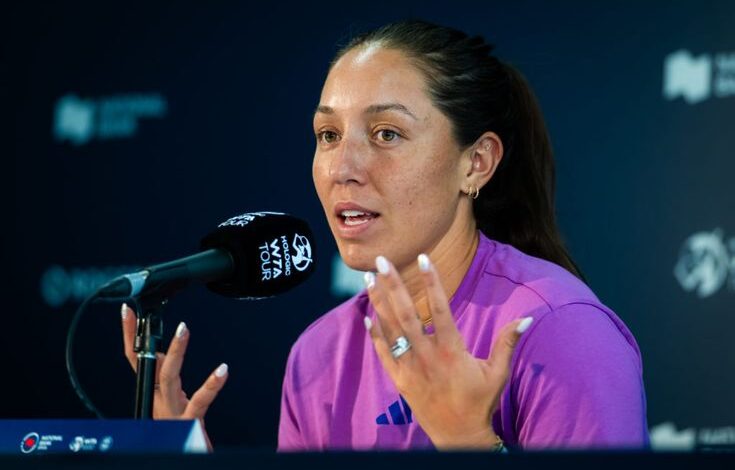
Jessica Pegula has outlined the reasons behind her decision to withdraw from the Qatar Open, offering clarity after questions followed her absence from the WTA 1000 event in Doha. In a social media post, the American cited the need to prioritise recovery after an intense start to the season, framing the move as a precaution rather than a response to serious injury.
Pegula’s withdrawal comes just weeks after a demanding Australian Open campaign, where she reached the semi-finals before losing to Elena Rybakina. That run represented another deep showing at a Grand Slam for the world No. 1-ranked American, reinforcing her reputation as one of the most consistent performers in women’s tennis. It also carried a significant physical load, something Pegula acknowledged indirectly in her explanation.
According to Pegula, the decision was made in consultation with her team, with the emphasis on managing her body after back-to-back high-intensity tournaments. She stressed that the issue was not a specific injury, but cumulative fatigue — a distinction that is increasingly important in modern tennis, where scheduling density can quietly erode performance even in the absence of acute problems.
From a performance-analysis perspective, the timing of the withdrawal makes sense. Pegula logged heavy court time in Melbourne, navigating a draw that demanded sustained physical and mental output. Data across the WTA Tour consistently shows that players who reach the latter stages of Grand Slams face elevated risk of fatigue-related dips in the subsequent weeks, particularly when transitioning quickly into Middle East hard-court events, which are played in faster conditions and often require long matches in compressed schedules.
Pegula’s Australian Open semi-final loss to Rybakina highlighted both her strengths and the margins she continues to navigate. While Pegula remained competitive throughout, Rybakina’s serve-first dominance and ability to shorten points proved decisive. Matches like that are taxing even in defeat, demanding sustained defensive work and repeated high-pressure service games. Recovery from such efforts is rarely immediate.
The Qatar Open has historically been a challenging stop for players coming off deep Australian Open runs. Travel, climate shift, and limited recovery windows often combine to test durability rather than form. Over the past several seasons, a notable proportion of top players reaching Melbourne semi-finals or finals have either withdrawn from Doha or underperformed in early rounds. Pegula’s choice aligns with a growing trend toward load management rather than automatic participation.
There is also a broader strategic layer. Pegula has built her career on consistency rather than peaks, and her match-to-match variance is among the lowest on tour. Protecting that consistency requires disciplined scheduling. Skipping a single WTA 1000 event may carry ranking implications in the short term, but it can pay dividends across a long season where health and availability often separate top-five players from the rest.
In her post, Pegula struck a calm, pragmatic tone, thanking fans for their support and reiterating her intention to return when fully ready. That approach reflects how she has handled similar decisions in the past — quietly, without dramatics, and with an eye on the bigger picture. Unlike some players who frame withdrawals defensively, Pegula’s explanation positioned rest as a performance tool rather than a setback.
The decision also speaks to her current phase as a player. At 31, Pegula is no longer building toward relevance; she is sustaining it. Her recent results suggest a player operating near her ceiling, but also one acutely aware that marginal losses in physical sharpness can swing outcomes against the very best. In a field where the top contenders are separated by fine margins, freshness matters.
Looking ahead, the withdrawal is unlikely to have lasting negative impact. Pegula’s ranking position and recent results provide a buffer, and her season goals extend well beyond early February. With major hard-court and clay-court stretches still to come, preserving health now may prove decisive later.
Ultimately, Pegula’s Qatar Open withdrawal is best understood not as a reaction to disappointment in Melbourne, but as a continuation of a measured approach that has defined her rise. She fell short of a maiden Grand Slam title at the Australian Open, but her semi-final run reinforced her status as a consistent threat at the biggest events.
By stepping back briefly, Pegula has chosen sustainability over immediacy. In a sport increasingly shaped by longevity and load management, that choice reflects not caution, but confidence — confidence that her level will be there when she returns, and that one tournament skipped can strengthen a season rather than weaken it.
Deprecated: preg_split(): Passing null to parameter #3 ($limit) of type int is deprecated in /home/ecoirdaz/facetechcourses.com.ng/wp-content/themes/jannah/framework/functions/post-functions.php on line 863