Why Fallon Sherrock speaks on difficult year after Cameron Menzies break-up and son’s health troubles
Deprecated: preg_split(): Passing null to parameter #3 ($limit) of type int is deprecated in /home/ecoirdaz/facetechcourses.com.ng/wp-content/themes/jannah/framework/functions/post-functions.php on line 863

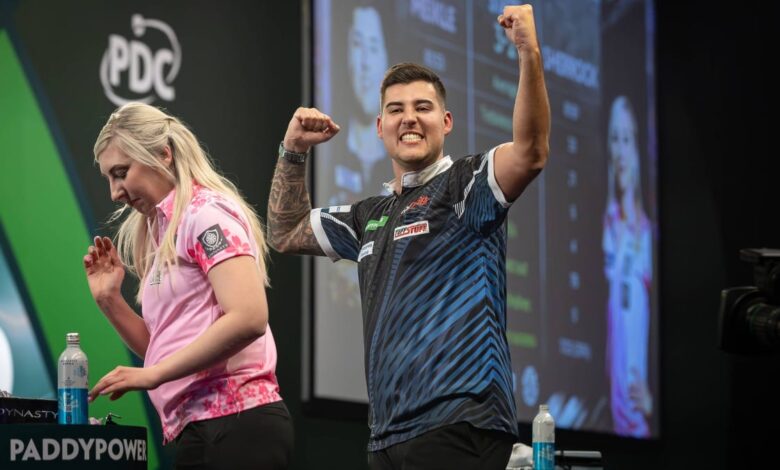
Why Fallon Sherrock Has Spoken Out on a Difficult Year Marked by Personal Upheaval and Health Concerns
As Fallon Sherrock prepares to step onto the Alexandra Palace stage once again, the familiar setting carries unfamiliar emotional weight. The World Darts Championship has long been the backdrop to her most defining moments, but this year her return comes after what she has described as one of the most challenging periods of her life — shaped by the end of her relationship with fellow professional Cameron Menzies and serious health troubles involving her son.
Sherrock’s decision to speak publicly about the year she has endured is notable. Throughout her career, she has largely shielded her private life from scrutiny, even as her profile grew exponentially following her historic Ally Pally breakthrough. This time, however, context matters. The period leading into the championship has not been defined by preparation alone, but by emotional strain that extends well beyond the oche.
The break-up with Menzies, confirmed earlier this year, marked the end of a long relationship between two players operating within the same competitive environment. While such splits are not uncommon in professional sport, the dynamics of darts — shared tournaments, overlapping schedules, and constant proximity — can intensify their impact. Sherrock has not framed the separation as dramatic or hostile, but rather as another destabilising factor in an already demanding season.
More significant, however, have been the health concerns surrounding her son. Sherrock has spoken about the fear and uncertainty that accompanied that period, describing it as something that inevitably reshaped priorities. In elite sport, where focus and routine are paramount, external stressors of that magnitude rarely remain compartmentalised. Sports psychology research consistently shows that family health issues are among the strongest predictors of performance volatility, often outweighing physical fatigue or technical form.
From a performance perspective, Sherrock’s results over the past year reflect that disruption. Rather than a clear downward trend, her season has been marked by inconsistency — strong performances interspersed with early exits. Statistically, her averages have remained broadly competitive within the women’s field, but variance has increased, a pattern commonly associated with emotional and cognitive load rather than loss of ability.
Sherrock’s openness now appears driven by timing. Alexandra Palace has always been central to her story, and returning there after such a year inevitably invites reflection. Speaking out allows her to frame that return on her own terms, rather than letting speculation fill the gaps. It also signals a shift in how athletes engage with narrative: offering explanation not as excuse, but as context.
There is also a broader health dimension that intersects with these personal challenges. Sherrock continues to manage a long-standing kidney condition, which requires constant attention to hydration and recovery. Balancing that alongside family stress and emotional upheaval compounds fatigue, both physical and mental. In darts, where margins are thin and concentration is paramount, cumulative strain can show up in missed doubles rather than visible collapse.
Despite everything, Sherrock’s career has not stalled. She remains second on the PDC Women’s Series Order of Merit, a ranking that reflects consistent accumulation of prize money rather than isolated peaks. That position underscores resilience. Even in a year defined by off-board difficulty, she has remained one of the most competitive players in the women’s game.
Her decision to speak now also carries symbolic weight. Women’s sport has increasingly moved toward openness around mental and emotional load, challenging the idea that professionalism requires silence. Sherrock’s comments place her within that shift, acknowledging that elite performance does not occur in isolation from life.
As she steps onto the Ally Pally stage, expectations are inevitably layered. History, public memory, and personal circumstance all converge in that space. Recreating the magic of her breakthrough years may be unrealistic, but that is no longer the sole measure of success. For Sherrock, simply arriving at this moment — still competing, still relevant, still willing to confront difficulty — is itself significant.
This World Championship appearance is not about redemption or revival. It is about continuity through disruption. By speaking about her difficult year, Sherrock has reframed her return not as a test of legacy, but as a reflection of resilience — on the sport’s biggest stage, and away from it.
Deprecated: preg_split(): Passing null to parameter #3 ($limit) of type int is deprecated in /home/ecoirdaz/facetechcourses.com.ng/wp-content/themes/jannah/framework/functions/post-functions.php on line 863